When the City of Evanston faced a critical boiler failure with no documented maintenance history, it became clear that their legacy systems weren’t meeting the needs of modern facilities management. Led by Mark Wegener, Lead Tradesman, and Karra Barnes, Asset Project Manager, the city’s facilities team adopted Novotx Elements XS and pioneered a barcode-driven workflow to improve operational efficiency, accountability, and long-term planning.

The Wake-Up Call: Why Evanston Needed a Better System
“We had a building with some steam boilers, and they failed,” Mark said. “When we got questioned as to why they failed and proof of all of our work, we’re like, ‘we don’t have much insight’. I know we do the work, I’ve done the work, but I don’t have any documented history on it,” Mark reflected.
This failure exposed the limitations of Evanston’s previous system and prompted a focused search for a platform that could meet their evolving needs. After evaluating options, the Facilities team found Elements XS to be the ideal solution, capable of supporting vertical asset tracking, preventative maintenance, and historical reporting. With Elements XS, Evanston began building a digital history of labor, parts, and performance for every major asset, laying out the groundwork for smarter capital planning and more confident decision-making.


The Solution: Barcode-Driven Simplicity for Facilities in Elements XS
Before Elements XS, Evanston used a legacy system that was difficult to navigate and inconsistent across departments. As Karra Barnes explained, “One of the Facility’s teams’ biggest complaints was how difficult the previous system was to navigate. When you have vertical assets, it was very challenging, requiring a lot of clicks.”
When the City of Evanston’s facilities team adopted Elements XS, they didn’t just digitize their maintenance records; they reimagined how frontline staff interact with assets in the field. At the heart of this transformation was a simple but powerful idea: make it so easy that anyone can do it.
To solve this, Mark proposed a barcode-based workflow that would eliminate excuses and streamline data entry. “We created the barcodes as a quick guide—you go to a piece of equipment, scan, enter your hours, fill out your timesheets, and start creating a history for our equipment,” said Wegener
This approach allows staff to scan an asset barcode using their phone and instantly pull up the record in Elements XS—no searching, no guesswork. It’s a direct path to getting asset information, logging work orders, labor, and materials.
Karra saw the potential immediately, “Mark’s idea to do the barcoding was really a good idea that solved our core challenges.”
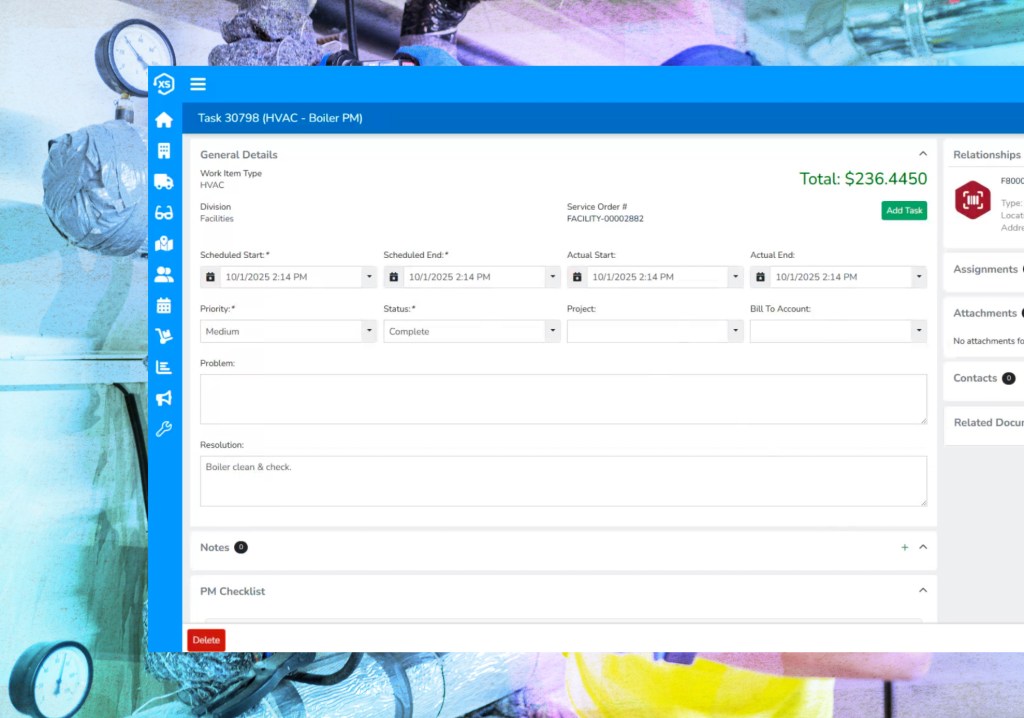
But Mark didn’t stop with just tagging equipment. To support this workflow, Mark created printed “gospel books” for each trade—HVAC, plumbing, electrical—containing barcodes for every major asset. These books serve as a backup when mobile devices aren’t practical, like during rooftop repairs in bad weather. Technicians can scan barcodes from the book and log work into Elements XS later, ensuring no maintenance goes undocumented. “It gives my guys no excuse as to why didn’t you add the labor, the hours, the equipment to the asset itself,” he said.
By embedding barcoding into their Elements XS workflow, Evanston’s Facilities team has made asset management intuitive, reliable, and scalable; laying the groundwork for preventative maintenance and capital planning.
From Maintenance Records to Capital Strategy
Elements XS has become the backbone of Facilities capital planning efforts. By systematically tracking labor hours, parts usage, and asset performance across all facilities, the city is building a reliable dataset to inform long-term investment decisions. This data helps identify patterns of recurring issues, flag aging infrastructure, and quantify the true cost of maintaining versus replacing assets.
“My goal is to utilize this as a tool to implement CIP projects… If I can create enough information and present that to council and the public, they’ll be like, ‘Oh, OK, yeah.’ That’s where I measure my success,” said Wegener

With Elements XS, Evanston can justify capital expenditures with confidence, using real-world evidence rather than estimates or assumptions. The platform also helps avoid unnecessary engineering studies by providing detailed maintenance histories and asset conditions, saving both time and money.

Impact: Elevating Facility Management Through Barcoding and Digital Workflows
Evanston’s adoption of Elements XS didn’t just introduce barcodes; it transformed the way facilities are managed. By pairing up Elements with the STRICH barcode scanning solution with a centralized asset management platform, the city created a system that is intuitive, reliable, and scalable across 60+ buildings.
This approach has:
- Standardized workflows across trades, ensuring every HVAC unit, boiler, and electrical panel is tracked consistently.
- Improved data quality by eliminating manual entry errors and making work order creation as simple as a scan.
- Enhanced accessibility for all staff, including those whose primary language isn’t English, by reducing complexity and training requirements.
- Built a foundation for preventative maintenance and capital planning, enabling data-driven decisions that extend asset life and justify future investments.
What started as a push for simplicity has evolved into a culture shift, where accountability, efficiency, and long-term planning are now embedded in everyday operations.
Future Plans: BIM and ArcGIS Indoors
Karra Barnes sees a clear path toward integrating advanced spatial technologies into Evanston’s asset management strategy. While Elements XS currently handles vertical assets, she envisions leveraging Building Information Modeling (BIM) for richer digital representations of facilities and eventually incorporating ArcGIS Indoors to enhance operational awareness and improve decision-making.
Interested in learning how barcode-driven workflows can improve your facilities operations?
Visit https://www.novotx.com to explore how Elements XS can support your asset and maintenance management goals.